
 By
A dental appointment runs on the dentist’s clock, and plenty of people leave the chair with a treatment plan they accepted without really understanding it. The visit works better as a two-way clinical conversation. The explanations given before treatment and the instructions given after it shape both the health outcome and the final bill.
Table of Contents
Signing a form is not the same as giving consent
Informed consent has a specific meaning in health care: the practitioner explains the diagnosis, the proposed treatment, the risks, and the alternatives, and the patient agrees on the basis of that explanation. The consent form that appears five minutes before a procedure serves a different purpose. Its main job is to create a record, and a record can be created without a single question being asked or answered. A signature on a form proves that a form was signed, and nothing more.
Turning passive consent into genuine consent takes a few direct questions, asked before anything is agreed. The first concerns necessity: what is this treatment meant to fix, and how firm is the diagnosis behind it. The second concerns options: most dental problems have more than one defensible response, and asking why this one is recommended over the rest shows whether the plan is a preference or a necessity. One question tends to go unasked: what happens if this waits. A dentist who says a small patch of decay can be monitored at the next check-up is giving different information from one who says the decay sits close to the nerve and delay risks a root canal. The patient who asks about timing learns how much of the plan is urgent and how much is elective, which is the difference between work that must happen soon and work that can be scheduled around pay cycles or annual insurance limits.
Ask to be shown the diagnosis, not just told
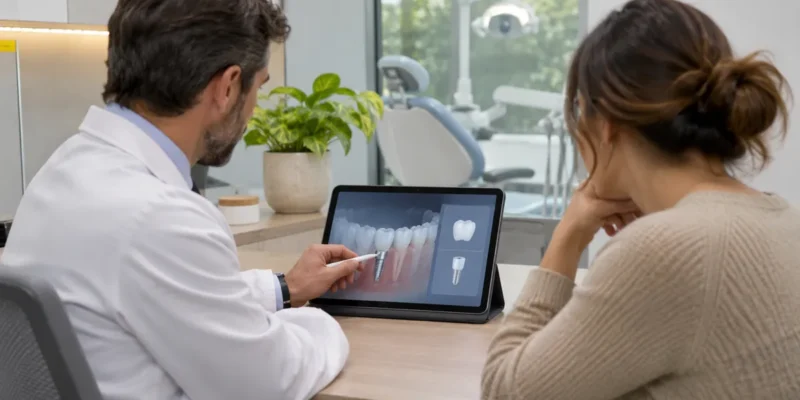
Dentistry is one of the few areas of medicine where the evidence can be put directly in front of the patient, since x-rays, digital scans, and intraoral cameras produce images a dentist can point to on a screen. Patients rarely use this, partly because the images look like gray blurs to an untrained eye and partly because asking feels like doubting the dentist’s competence.
The simplest approach is to ask to see where the problem is on the image, explained in plain words. A second request changes the exercise: ask what a healthy tooth would look like in the same position. A reference point turns an abstract shadow into something that can be judged, and it lets the patient follow the reasoning and weigh the conclusion.
A dentist willing to do this, turning the screen, tracing the outline of a nerve canal or a shadow of decay, and checking that the explanation has been understood, is showing the patient the evidence behind the recommendation. That has practical value beyond reassurance: a patient who has seen the problem can describe it accurately at home and, if a second opinion still feels worthwhile, can walk into that appointment with sharper questions.
Get the plan and the price in writing
Cost questions deserve time during the treatment discussion. A verbal estimate given over the chair does little to help, since it can’t be checked against a health fund’s rebate schedule, and it has a way of growing once work begins.
Ask for the treatment plan as a written document with item numbers, a description of each stage, and a fee beside every line. Those item numbers let a patient phone their health fund, quote the codes, and learn the actual out-of-pocket gap before anyone picks up a drill. Ask, too, whether laboratory fees for crowns or dentures sit inside the quoted figure or arrive later, and how the clinic handles discoveries made mid-treatment, when a tooth is open and the plan must change.
Staging is the last piece. Asking which parts of the plan are urgent and which can wait a month turns one intimidating figure into a sequence that can be budgeted, and a clinic that has thought about its patients’ finances will have a ready answer. If the answer is that everything is urgent, that’s worth knowing too. At that point the decision shifts from scheduling the work to seeking a second opinion on the diagnosis itself.
Ask what normal recovery looks like before you need to know
Most post-operative problems are minor and short-lived, but the patient who can’t tell normal soreness from a developing infection either worries needlessly or waits too long, and both outcomes are avoidable with a two-minute conversation before leaving the chair. The question is what recovery should look like day by day: how much swelling is expected, when pain should peak and start easing, and which symptoms mean the clinic wants a phone call.
The standard example is alveolar osteitis, better known as dry socket, which can follow an extraction when the clot protecting the bone is lost early. Its signature is pain that gets worse a few days after the procedure, when it should be easing, often with a bad taste. A patient briefed on that pattern calls the clinic promptly instead of taking extra painkillers and waiting. On pain relief itself, the sensible question is what the clinic recommends, with a pharmacist able to advise on options like paracetamol where the dentist’s instructions allow.
Multi-stage work needs its own questions. A root canal typically spans more than one visit with a temporary seal in between, so it’s fair to ask what the temporary filling can handle, what happens if it cracks before the next appointment, and whether the final crown is included in the quoted fee or priced separately. The same applies to crowns and bridges, where a bite check after fitting is part of doing the job properly; ask whether that adjustment visit is covered or billed as a new consult.
Follow-up visits and after-hours care
Follow-up appointments are where treatment plans quietly succeed and where unexpected charges tend to appear. Before agreeing to anything, ask whether the review appointment is included in the fee, whether suture removal is covered, and whether small refinements like bite balancing on a new crown are part of the original price or billed as separate consultations. A planned recall check a few months out is how a clinic confirms that tissue has healed and that a denture or bridge has settled properly.
Then there is the question nobody thinks to ask until something goes wrong at nine on a Friday night: who to contact after hours, and what actually happens when that call is made. Some clinics hold same-day emergency slots and publish clear arrangements for weekends, while others direct patients to a recorded message, so it is worth asking any provider, including any dental clinic lutana patients use, what after-hours contact arrangements exist before treatment begins.
These answers are rarely hidden, but they often aren’t volunteered. A clinic with a genuine triage process will explain it in a sentence or two, including who decides whether a problem needs attention tonight or can safely wait until morning. That explanation is itself evidence of how the practice treats people once the clinical work is done.
Questions to ask for children and older adults
When the patient is a child, the child can ask questions alongside the parent or guardian, with answers given in words the child understands, and the questions should cover the hours after the appointment as much as the procedure itself. Ask how long the numbness from a local anesthetic is likely to last and how to keep a child from chewing a lip or cheek while it does, what can be eaten that evening, and which follow-up milestones the clinic expects, whether a review of a filling or a check on an extraction site.
For older adults, particularly those on several medications, the pre-treatment conversation should start with the medication list, because some drugs affect bleeding, healing, or the dryness of the mouth, and the dentist needs the full picture, not the two or three prescriptions the patient happens to remember. Caregivers should ask who receives the post-operative instructions and whether they can be provided in writing, since a spoken summary delivered to someone still numb and tired won’t survive the trip home. In both cases, the question underneath is whether the clinic makes the plan understandable to the person responsible for carrying it out. Written instructions, a direct phone line for worried parents, and a willingness to repeat information without sighing are small details that reveal how follow-up problems will be handled.
Reading how a clinic handles questions
A clinic’s communication habits are on display from the first question asked during a consultation. Impatience is a warning sign, whether it shows up as answers that shorten with each follow-up, jargon repeated at higher volume instead of in plainer words, or reluctance to put anything in writing. Pressure to decide on non-urgent work before leaving the building belongs in the same category.
The positive signals are just as easy to spot: a dentist who turns the screen around, prints the plan, and checks understanding by asking the patient to say it back in their own words. For people with dental anxiety, which leads many adults to put off care for years, a willingness to narrate each step before it happens is often what determines whether the appointment happens at all. If a clinic resents questions during the consultation, when the patient is still free to leave, how will it treat a worried phone call a few days after a difficult extraction?
Professional bodies such as the Australian Dental Association publish guidance on patients’ rights to clear information and on the standards expected of practitioners in obtaining consent, which gives anyone who feels brushed off a reference point beyond their own instincts. None of this requires confrontation. Asking questions in a measured tone, and writing the answers down, is enough to change how most consultations run.
If you are also comparing clinics for cosmetic work, our guide to choosing a cosmetic dentist covers further questions worth asking.
Write the questions down before the appointment, because memory fades in the chair. A clinic that welcomes a written list says something about how the rest of the relationship will go.













Comments